2.27.2009

Equality of Luck


Suppose there are two farmers, Robinson and Friday. There are two distinguishing features of the farmers: Friday drinks beer all day and farms occasionally while Robinson works hard all day and reaps twice as much. Most people would say Robinson's extra earnings are just, since he is rewarded for working twice as hard or because his mind is twice as clear or brilliant. Even though Robinson has more resources than Friday, this also seems fair, since the laws of reality that reward labor and value are applied equally. But let's say that Friday also happens to be lazy, and throws all his empty beer cans onto a heap in the corner, and one day the price of aluminum skyrockets, putting Friday's earnings far above Robinson's. The situation remains fair, since the laws of reality continue to apply equally to each - the price of alluminum was the same for both farmers - even though the outcomes were different. It also remains just, since the rewards for labor and value dictated by the nature of reality remain upheld. Unfortunately, this law does not always operate smoothly. Sometimes there is an element of luck involved which gives outcomes the appearance of injustice and unfairness. This can have a crippling affect on individuals; it shows them that their carefully calculated formulas for estimating the rewards of labor and value were wrong - shattering their entire view of reality and replacing it with an irrational, unpredictable view that is inhospitable to human life. Unfortunately, the only way to sterilize this dangerous and immoral facet of reality would require redistribution, injustice and unfairness, and so we are doomed to cope with and overcome this property, and hope this doesn't involve holding a malleable, uncertain view of reality.

2.25.2009

The Economy


Being an economics major, I'm slightly embarrassed to have gone so long without commenting on the current crisis or the government's plan of action (though I have been in some sort of unhealthy denial so far. There's a governmental externality you won't learn about in 101 or 102). I don't have much time to keep up with current events, but from what I can see, Obama and his goons seem to be claiming moral justification for their berserk spending - whatever that means for a "pragmatist". The only way I can make sense of this is if they're hoping to decrease unemployment and therefore dampen suffering. And from what I can tell, they came up with this idea by bastardizing a perfectly good economic rule: Okun's law. Though it isn't so much a law as an observation, Okun pointed out that GDP and employment are proportional: which makes sense - more people making stuff means more stuff is changing hands. What wouldn't make sense is to say that, people moving products around causes them to produce more. GDP is an emergent property of an unimaginable complex system - and it's probably the only system in which one can even conceive of increasing the parts by increasing the outcome. You can't increase the number of neurons in a brain by increasing the level of consciousness, you can't increase the amount of paint in a masterpiece by increasing the amount of art occuring, you can't increase the amount of ram in a computer by increasing its power. And, as we'll see in a few years, you can't benefit the participents of an economy by focusing on the end statement. Okun's law isn't about getting your paycheck and buying things with it - it's about focusing your efforts to create something of value and exchanging it for the product of someone else's labor. And the one thing the government is undeniable incapable of producing something of value.

1.10.2009

Watchmen: Great Fun, Just Don't Think Too Hard


!! WARNING: SPOILER ALERT !!

For Christmas, a good friend of mine gave me a copy of Alan Moore's Watchmen. Few narratives have captivated me more or left me more impressed with such deeply developed characters. After first opening it, i was nearly unable to set it down, even when in the company of my friends...that is, until chapter 9. It's hard for me to say this about an anarchist, but Moore seems to have been stepping outside of his creative boundaries when he explicitly tried his hand in the realm of ideas, a place he certainly doesn't belong. In chapter 9, Doc Manhattan (a character who I really loved up until this point), after learning that he's responsible for terminal cancer in his loved ones, flees to Mars, eventually bringing his wife, Laurie up with him, and sheds all concern for human affairs. He explains to Laurie what any entity with near perfect omniscience would understand as having real universal value over human life: big mountains and valleys, the bigger and badasser the more valuable. Notice it's not any idea of beauty, but some juvanile, ungraspable idea of the sublime. Instead of asking him what he thinks value actually means, Laurie tells him stories of how awful it can be to interact with people - because it wouldn't make you feel awful if they weren't valuable, right? Someone could tell me that I'm reading too far into it, that it's just supposed to be a story without profound mmeaning. But of course, if that's true and the story doesn't have any ideas or implications to the real world, then it's a much worse story than I'm giving it credit for.

Anyway, Doc Manhattan is eventually convinced that humans do matter for something when he comes up with the idea of humans as "thermodynamic miracles." The idea is that, in order for you to be sitting here reading this, the sperm cell that eventually became you needed to fulfill an event with a 1:1000 or so probability of happening. Repeat that for your parents' existence, and similar odds for their meeting in the first place, and it really starts to seem like a miracle that any of us made it here. On top of being completely disgusted at the idea that humans need a justification for their existence, I realized that the idea doesn't work on at least two levels. 1) The "Thermodynamic Miracle" idea doesn't serve the purpose of persuading Doc to come back to Earth, since the position and velocity of every particle on Mars (which Doc is able to percieve perfectly) would have an infinitely higher improbability of occuring than the creation of a person. This makes Mars still more "valuable," according to his knee-jerk "badass factor" of value, than humans. 2) There are two ways of portraying clairvoyance in science fiction. One of them (Philip K. Dick among its patrons) involves many possible outcomes, depicting events as an ever-branching tree which allots room for an individual's free will to decide one branch or another. The other is strictly deterministic, in which outcomes are unavoidable. Which one is possible has been a question in philosophy for centuries, and Doc comes down on the side of strict determinism. Other than having strange implications for punishment, this is a blatant contradiction with the "thermodynamic miracle" idea. If determinism is true, and every event was decided at the creation of the universe, then the fact that you're sitting here isn't the least bit suprising. There wasn't for a second any doubt that you wouldn't end up existing and sitting right there.

Olympus Mons isn't a standard of value to measure humans by. Value begins and ends in the individual, and it is only because humans are aware of Olympus Mons that it's even a candidate for being a thing with value.

What really makes me itch is thinking that if I had read Watchmen two years ago, when I was less sure about what makes a good idea, and less sure about my worldview, I would have taken a lot more enjoyment out of reading it. I do, however highly recommend reading it and seeing the movie; just be sure to focus on the artistic aspects, and not the philisophical aspects, if you want to get your money's worth.

10.16.2008

God Can't Even Tip Over a Chair

When I was in middle school, me and my group of friends frequented a game called World of Warcraft. In it, there was a sword called "The Unstoppable Force" and, in an unrelated area, a shield called "The Immovable Object." Of course,a common lunch-time discussion became: what would happen if they ever met? Among the many ridiculous solutions we came up with, the serious answer we all agreed on was that the two couldn't exist in the same universe. Their mere simultaneous existence would be a paradox.

Fast forward to a couple days ago, I was thinking about the contradiction of omnipotence - can God create a stone so heavy that even he cannot lift it? And, my favorite, the contradiction of omnipotence and omniscience - can God do something that even he did not forsee? Unless you defualt to the non-answer that God is unintelligible by humans, you're going to have to accept 'a contradiction exists' as your answer - that God can create a stone so large that he can't lift it and that he can lift it. But this makes one huge assumption: that paradoxes aren't absolutely impossible, which they are by definition. If A does indeed = A, then there is a limit on God's power, and that limit is rule of non-contradiction.

An absolutely powerful force cannot exist in the same universe as an absolutely impossible action. This isn't up for debate, it necessarily must be true by definition. Saying that God is more powerful than paradoxes or that God is mysterious doesn't negate this argument, since the infinite power of God is the cause of the problem.

The only objection I see that could be made is that paradoxes are not absolutely impossible. I can't see someone making this argument without begging the question (God is all powerful, therefore he can make contradictions happen). I also know Aristotle said that without the rule of non-contradiction, we couldn't know all that we do know. I'm not entirely sure why he thought this, but it probably had something to do with the devastating blow that the existence of a contradiction would deal to identity.

At any rate, I should point out that the stakes are in all of this are extremely high. Everything that God does in the bible, or anything that he could possibly do is a contradiction. Everything he does is a miracle, and the point of a miracle is that it's doing something impossible. But if something can't be done...and yet it can be done, well there's your contradiction right there! So how far does this go? Most believers in an absolute power will tell you that tipping over a chair is certainly within its sphere of power. More specifically, a chair that wouldn't have tipped over otherwise. And if a chair wasn't going to tip over, then it couldn't have tipped over since the necessary elements weren't present (or else it would have tipped over). And if something couldn't have happened and could happen at the same time in the same way, then either paradoxes aren't absolutely impossible, or it exclusively couldn't have happened. But, as I mentioned above, paradoxes almost definitely are absolutely impossible. Therefore, God can't even tip over a chair.

9.08.2008

In Attack of the Beta Blockers

A lot of people have been blogging about the Olympics (I'm a little slow, give me a break), and I decided to get in on the action. But since the politics of possibly sanctioning a tyrannical chronie-capitalist country has been covered pretty extensively, I'm going to take the road less traveled and touch on a topic that's been getting less discussion than its interesting-level deserves: performance enhancing drugs. More specifically, the use of beta blockers. If you haven't heard of beta blockers, I suggest reading Carl Elliott's excellent article on their use in the Beijing Olympics. In it, he describes two North Korean marksmen who were ousted for using propranolol, a drug more commonly used for blood pressure which has been widely used since the 70s to reduce the signs of anxiousness. Elliott then goes on to defend the use of beta blockers in sports (or any other stressful situation, for that matter), on the grounds that they even the playing field between the nervous athlete and the calm athlete. After all, if I miss all 6 of my shots just because I'm being televised, then the people watching at home aren't seeing the real skill behind my shaky hands.

But there's on clear element that Elliott failed to address: why strong nerves shouldn't be considered one of the virtues of an Olympian athlete. We don't assume that the Olympics are done in a vacuum, or that it's some sort of an experiment done solely to see who is truly the fastest or strongest or most accurate. The Olympics is an overt public event, and being able to perform in a stadium with the whole world as your audience is as central and impressive a quality as any other demanded by your sport. After all, if we wouldn't we assume that a shaking neurotic is less Olympian material than a courageous, assured paladin? And wouldn't the former be worthy of blame if he could only use drugs to compete with the later?

I do, however, share Elliott's eagerness to have my heart surgeon popping some beta blockers before he opens me up.

7.20.2008

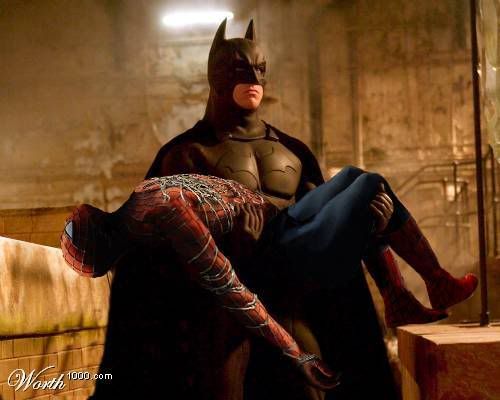
Batman vs. Spiderman: Good vs. Evil


This week I saw two of the most recent comic book movies, Spiderman III and The Dark Knight, both starring jewish superheros.* It's really striking how opposite the two are: Spiderman is sappy yet realistic, Batman is cold yet romantic; Spiderman draws on the powers of his body to define himself while struggling against alienation, Batman's power lies in his mind (and his pocketbook) with a crystal clear picture of justice; the enemies in Spiderman are cool and flashy - even enviable, Batman's baddies are as unsavory as they are interesting. This last difference embodies the core difference between the two, which i see as: a deliberate and thought out portrayal of good and evil (Batman) vs. a deliberately ambiguous and near amoral portrayal of existentialist problems (Spiderman).

One of the main differences between Spiderman and Batman is what exactly they point their "powers" at. Since half of Spiderman's enemies are within himself in the form of identity problems, he uses his powers to gain respect and admiration by the citizens of NYC. In fact, Parker's happiest moment in the series is when a parade is thrown in his honor. And what citizens of NYC admire the most is flashy theatrics such as stopping runaway trains and cranes. The bad guys also have something in common with the runaway crane operator: they just made an honest mistake. The movie is constantly trying to get you to sympathise with the baddies. Now this just rubs me the wrong way. What exactly is spiderman doing while he's flipping through the air like a jackass? Well, mostly just doing flips, but what he's not doing is what a hero should be doing: fighting evil or anything that requires principles. What's more, spiderman's baddies are more principled than he is, saying things about him like, "That just doesn't seem right to me." The result of having baddies who are only victims of circumstance is that Spiderman ends up using his powers to save people from themselves. That seems to me like the job of a mom, not a super hero. And just like a mom, this has the effect of showing NYC that it would be helpless without him, and by asking for nothing in return, the citizens have no choice but to love him. Even when I managed to turn my brain off, I still didn't care who won. When both sides have the same amount of justification, and the bad guys are way cooler - I mean come on, he's made out of sand! - how am I supposed to root for Spiderman?

Batman, on the other hand, wouldn't dream of wasting his time caring what society thinks. Batman turns away from social reality and Gotham's concept of justice in favor of his own view of justice as dictated by nature. He spends half of his fortune on flashy sports cars and party entrances, on creating the Bruce Wayne everyone expects him to be - a carefree playboy. But the real carefree in Gotham are baddies like the Joker and the Riddler, people without principles or purpose, but with a makeshift and laughable sense of morality (remind you of spidey?). What makes Batman's baddies so interesting is that they represent some form of evil according to the author, which is also what creates their unsavoriness and makes you root for batman.

And as for the obvious question: Batman would kick Spiderman's ass - he's got to have a can of raid on that belt somewhere.

______________________________
*Ironman, however, is not jewish, but his sidekick, Goldman, the clairvoyant accountant, is.

7.15.2008

A Mugger In Rags


A couple weeks ago, I had the pleasure of spending a week in Philadelphia while attending an IHS program about liberty and society. Three days into the week, I tasted my first authentic philly cheesestake while exploring the city. Me and some of the other lecture patrons were standing on a street corner enjoying our hoagies when pan-handler came a handlin'. "Can I you give me some change? I need something to eat. I'm really hungry." Overcome with pity, I gave him some loose change and shrugged off some of the guilt. And yet, I couldn't help but feel like something about the situation was horribly out of place and I didn't feel content about helping to feed the poor guy. It took me over a week to figure out what was missing - the barrel of a gun. He was coercing on the deepest scale; the only difference between the tramp and a visibly armed mugger was that a mugger wouldn't have asked me to pretend that the expropriation was voluntary. But it wasn't voluntary and the tramp wasn't unarmed, his weapon was guilt, and the more compassionate you are, the larger his gun becomes. Now I can't help but imagine how many bums are using the veil of a panhandle to disguise their grip on our good intentions to get a free ride.

"But we need to help those less fortunate than ourselves," our consciences plead. And how unfortunate that our consciences can so easily drop contexts. Help them to do what? To escape hunger for a few hours? I have more faith in my conscience than to assume it places such a high value on such a temporary fix. How could compassion be so heavily directed towards your neighbors stomach? If compassion is to be of any value, it needs to be reserved for your neighbors mind, his only truly valuable asset. This means that when you give change to a bum out of brotherly love, what you really feel fuzzy about is being able to help them back up on their feet.

I'm not going to say that you shouldn't give to the poor, or even that you shouldn't feel good while doing it. I'm only saying that by truly understanding why you're giving, you can escape the feeling that you're fulfilling some sort of duty by emptying your pockets. After all, the fact that charity isn't obligated is what makes it so compassionate.